Nice to meet you!
I am an assistant professor and board-certified medical physicist with the Department of Radiation Oncology at the University of Michigan.
My research interest lies at the intersection of physics and biology. I contribute my physics expertise in the precision and rigor of radiation delivery to the physics-biology collaboration, investigating the fundamental molecular mechanisms of low dose radiation therapy (LDRT) for osteoarthritis (OA). Despite multiple decades of empirical evidence supporting LDRT for OA, its mechanistic picture remains incomplete. With this research effort, I hope to further clarify the role of LDRT in OA management, refining a useful treatment so that it benefits more patients with OA, who critically need more treatment options.
I am passionate about engaging patients and care-givers as equal partners in both research and quality improvement. To this end, I completed training as one of the inaugural scholars with the Michigan Embedded Learning Health System Training and Research ( MEL-STaR) AHRQ P30 Funded Center.
On the clinical side, I am interested in workflow optimization to reduce documentation burden, particularly through the implementation of novel ClinOps analytics. I am Epic certified in Cogito, Caboodle Data Model, Clarity Data Model and Access Data Model.
Enhancing the medical physics talent pipeline to foster growth in our field is one of my greatest educational motivations. I am currently co-leading the preparatory efforts with my colleague Alex Moncion to seek accreditation of our certificate program in medical physics by the Commission on Accreditation of Medical Physics Education Programs ( CAMPEP).
I enjoy solving scientific/quantitative problems programmically. In particular, I am fluent in Python and familiar with its scientific ecosystem (i.e. NumPy, SciPy, Matplotlib, LmFit, Mayavi, scikit-image etc.). I like readable, elegant NumPy vectorization solutions, but am also comfortable with extending Python via Numba or pybind11/C++ for numerical performance boosting. For larger coding projects, I use C#/.NET (LINQ is marvelous) and strive for robustness and maintainability through good software engineering principles.
In my free time, I enjoy rowing on the beautiful Huron River with fellow club members from the Ann Arbor Rowing Club. 🚣🏻♂️
Education, Training and Credentials
| 2023 | Board Certification, American Board of Radiology |
| 2020–2022 | Medical Physics Residency, University of Pennsylvania |
| 2018–2020 | Research Fellow, Mayo Clinic Rochester |
| 2015–2018 | Research Associate, Brookhaven National Laboratory |
| 2015 | Ph.D., University of Colorado Boulder |
| 2010 | B.E., Zhejiang University |
My journey
Before moving to Ann Arbor, Michigan, I completed my residency training at the University of Pennsylvania, where I also served as the physics resident education officer.
My training in medical physics started at the Mayo Clinic, Rochester, Minnesota, where I completed a CAMPEP-accredited postdoctoral certificate program. While working as a research fellow there, I developed a GUI software application for real-time motion management for proton therapy. This custom tool, named Wukong, provides added assurance for internal tumor/target localization during setup and beam-on. It has been translated into clinical use as a standard operating procedure (SOP).
In my earlier basic science pursuit, I studied nanoconfined polymer electrolytes for safer rechargeable lithium-ion batteries at the Brookhaven National Laboratory, via synchrotron x-ray scattering experiments performed at the Advanced Photon Source and the National Synchrotron Light Source II.
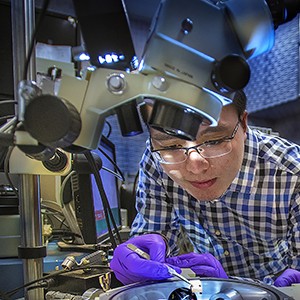
Zheng Zhang, Ph.D., DABR
Assistant Professor
Radiation Oncology
University of Michigan
How to say my name